Martí
También esto pasaráMartí enters Blanca’s story first as a striking stranger at her mother’s funeral, then as a possible new romantic connection in Cadaqués. The attraction between them develops through brief, playful encounters, but his presence also carries a family history: he has come to honor a kindness Blanca’s mother once showed his father. Their connection therefore begins with a debt of gratitude before it becomes flirtation, and the narrative leaves its future open.
Identity and Background
Blanca initially recognizes Martí by his distinctive appearance rather than by name. At the Marítim, where he is reading a newspaper among the longtime local patrons, she notices his large, powerful-looking head, lively and quick eyes, brown beard, abundant lighter hair, prominent nose, and long, lean but strong body. His presence has already caught her attention at the funeral, though they have not yet been introduced. The encounter is charged less by anything he has done than by the combination of his looks and the circumstances in which she first saw him.
Martí’s brief account of his family explains that he was born where he now lives, while his mother is Catalan and his father was Argentine. His father once ran a bar, but was, in Martí’s account, poor at business; the bar eventually closed, and his father returned to Argentina. Martí says his father died some years before the events in Cadaqués. The details are modest, but they place Martí between his father’s Argentine past and his own life in Catalonia, and they give his visit to the funeral a personal history beyond the immediate attraction Blanca feels.
His Connection to Blanca’s Mother
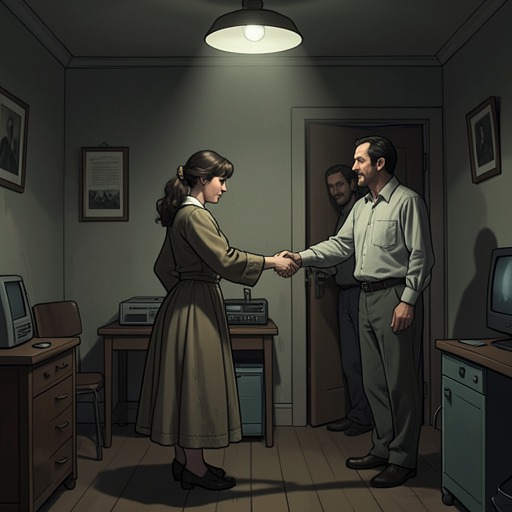
The link between Martí’s family and Blanca’s begins with a story about his father. After performing at a show, his father spoke with Blanca’s mother, who came down from the upper part of the city and was moved by his songs. They were not close friends; they were acquaintances who sometimes talked, as people do when they meet regularly in a bar. When he admitted that he was in financial difficulty, Blanca’s mother invited him to her office the following day, asked how much he needed, and took the money from a drawer. She did not ask what it was for, when it would be repaid, or for any guarantee.
Martí says his father returned every peseta. More important to the explanation he gives Blanca, his father never forgot the gesture. When Martí learned that Blanca’s mother had died and would be buried in Cadaqués, he decided to attend the funeral to pay his respects and thank her on his father’s behalf. The action makes his appearance at the ceremony an act of remembrance rather than a casual intrusion. It also reveals a side of Blanca’s mother that is carried forward through someone outside the family: her generosity had made a lasting impression on a man she scarcely knew, and his son has inherited the obligation to acknowledge it.
Encounters in Cadaqués
After seeing Martí at the Marítim, Blanca encounters him again at the casino, seated in the dim area where village regulars play cards. She reads his repeated appearances as almost a sign from her mother, who had worried that Blanca had not been truly in love for a long time and had teased her about it. Blanca sits at the neighboring table, and Martí smiles as if they already know one another. His first question turns on a shoe she may have lost, beginning their exchange with a lightness that fits the playful, game-like mood Blanca associates with courtship.
Their next meeting takes place outside the casino, where Martí is drinking beer with friends. He gets up and comes over to greet her. Blanca notices the peeling skin on his nose and his big toe showing through a dirty, hole-ridden espadrille. She is on her way to meet Santi, but the prospect of that rendezvous has already begun to lose its pull. Martí’s presence draws her attention away from the appointment, while her own sunlit appearance and anticipation of an evening out make her feel newly attractive. She thinks he may be younger than she is, though this remains her impression rather than an established fact.
When Blanca asks his name, he answers that he is Martí, and she gives him hers. They join his group, which includes a young man and two women. The group receives her warmly, with the teasing, amiable curiosity she associates with the Empordà. The women talk freely about men, and the men listen without falling back on the tiresome generalizations Blanca expects. The social ease of this gathering gives her a glimpse of Martí among friends, not merely as the handsome stranger she has been watching.
The Espadrille and an Unsettled Possibility
The flirtation sharpens around Martí’s worn espadrilles. Blanca asks to try them; he hesitates, then removes one and places it before her. She slips her foot into the large shoe, noticing its dry, hard esparto sole and faded navy canvas, stiffened and marked with white lines of sea salt. It fits. Looking at her red-painted big toenail inside the oversized shoe, she says she thinks she will keep it. Martí answers by comparing the moment to Cinderella finding the shoe that fits her.
Blanca recognizes the fairy-tale echo, carefully pulls her foot free, and returns the espadrille. She then leaves, kissing him at the corner of his lips and hurrying away before, in her playful imagining, her princess’s dress turns to rags and she becomes a pumpkin. The gesture makes her interest tangible, but it does not settle into a declared relationship. She is still headed to meet Santi, and the text presents Martí as an opening toward possibility rather than as a replacement already chosen.
Narrative Role
Martí’s role is built from two kinds of attraction: the sensual immediacy of his appearance and the inherited moral weight of his visit. Blanca first notices his body and gaze; then learns that the man at the funeral came because his father had remembered her mother’s kindness. The narrative places those revelations alongside Blanca’s own ambivalence about love, her fear of loneliness, and her tendency to approach romance through play. Martí becomes a new possibility at precisely the point when she is questioning the relationships and defenses that have kept her from trying to build something lasting.
The espadrille gives their encounter a small, concrete emblem. It is worn, salt-marked, and unexpectedly fits; the Cinderella comparison turns a mundane act into a flirtatious test of recognition. Yet the scene stops before the metaphor can promise an ending. Martí has introduced himself, shared his father’s story, and met Blanca’s kiss, but no lasting relationship or later outcome is established here. His significance lies in that suspended moment: a past act of generosity brings him to Blanca, while a playful exchange leaves open whether gratitude and attraction will become a shared future.